
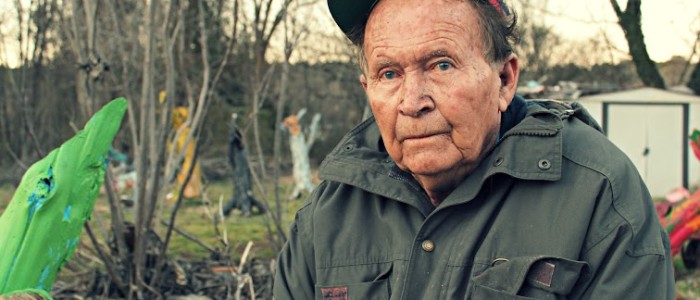
Folk artist Clyde Jones (1937 – 2025) of Bynum, NC, was recognized by scholars as a Visionary Outsider Artist. Clyde was a beloved community member, dedicating his life and work to children of all ages. Best known for his iconic, whimsical wooden “Critters”, sculpted with a chainsaw out of cedar logs, Clyde’s paintings are also widely collected. Clyde never sold his art but generously shared his time and talent throughout life. His work is found in private collections, museums and galleries across the US and has been featured in magazines and books worldwide.
Use the following links to learn more about Chatham County’s Clyde Jones, his impact on our community and the restoration of the Salisbury Street Mural:
- Clyde: His life, his art (the early years)
- ClydeFEST and community building through Chatham Arts Council
- Restoration of the ClydeFEST Mural
- Other ways to get acquainted with Clyde Jones (videos, documentaries, books, etc)
Clyde: His Life, His Art (the early years)
More than anything, Bynum folk art legend Clyde Jones liked to make children smile. For decades, he had an unconventional way of going about it – by revving up his chainsaw. It worked. And kids weren’t the only ones smiling.
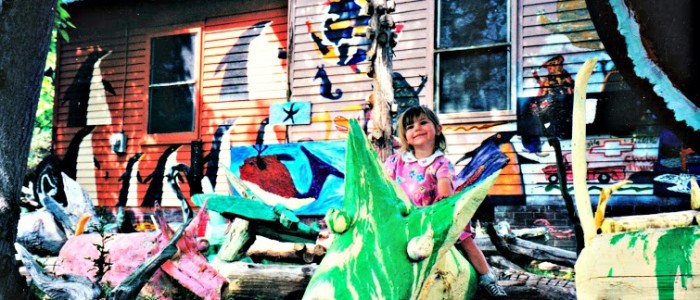
Clyde started with log remnants or an old stump. With a few swipes of his saw, some hammer and nails, and perhaps a coat or two of paint, a “critter” was born. Plastic flowers, tennis balls, artificial grapes, and bottle caps became eyes. A pair of panty hose or a clip-on braid became a tail. Some got saddles or a string of lights. The lucky ones got a frosting of glitter.
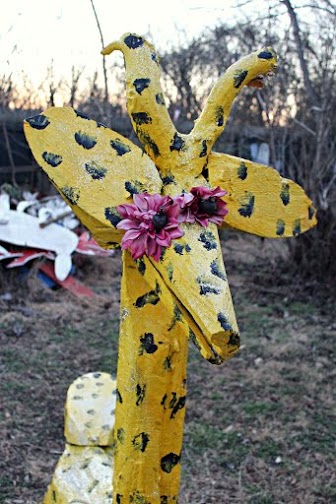
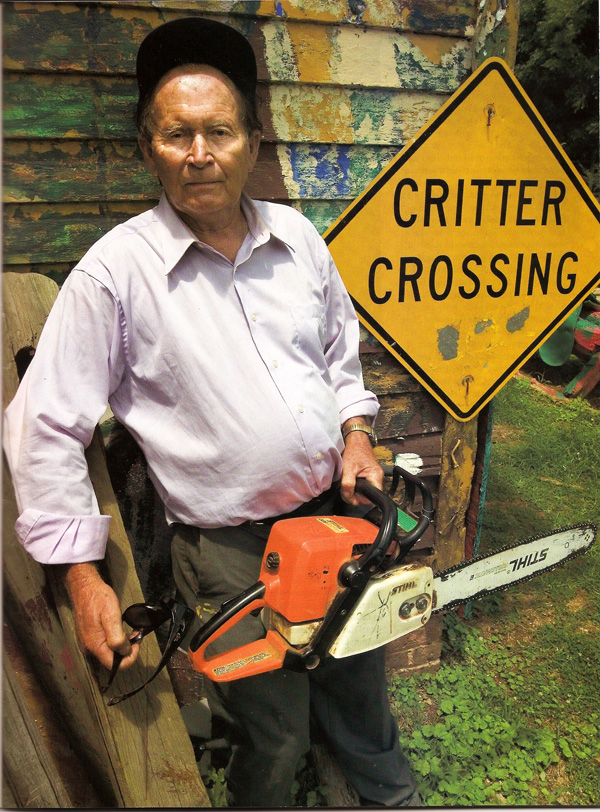
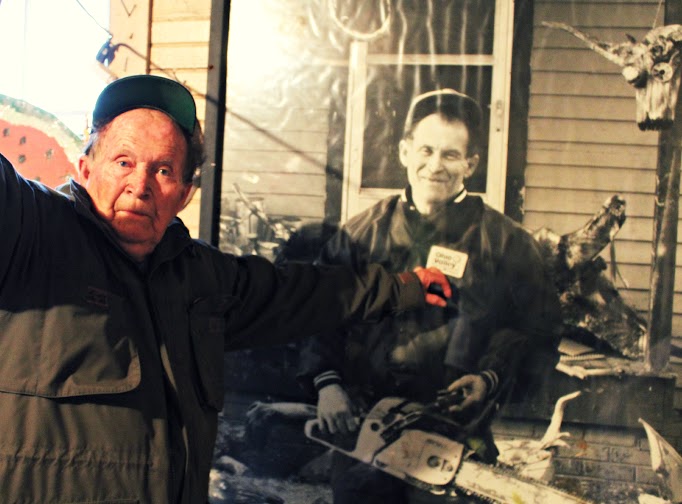
Clyde started creating these fanciful dogs, horses, giraffes, elephants, anteaters, ardvarks, and other beings in 1982. His yard in the former mill town of Bynum was full of them. And the world took notice.
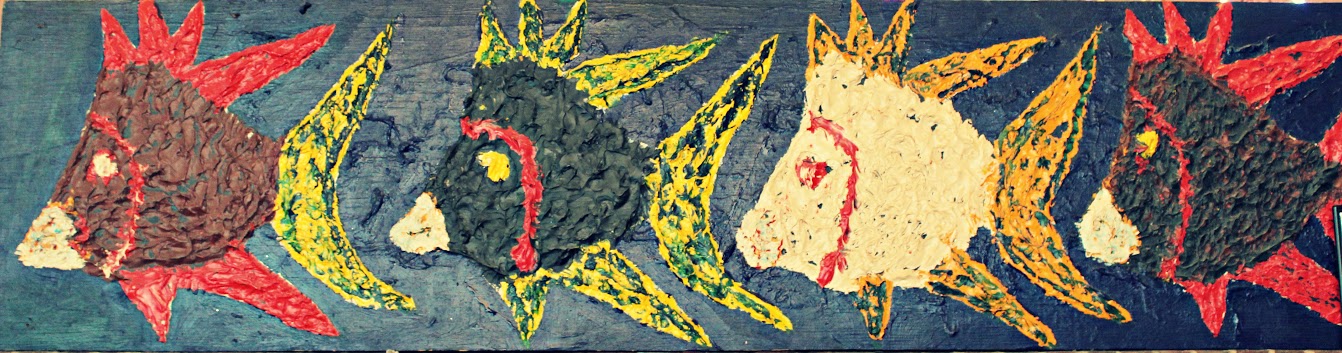
Clyde’s creatures have been on display at the Smithsonian Institution in Washington, DC, the American Visionary Art Museum in Baltimore, and as far away as Africa and the Great Wall of China. He made a star appearance in New York City and has been featured in several documentaries. He also created large, textured folk-art paintings.
But they aren’t for sale. Never have been. “You can’t buy one, but I like it when people come and take a look,” Clyde said. In fact, when famed Russian ballet dancer Mikhail Baryshnikov arrived in a limousine in 1991, Clyde politely refused to sell him one.
Instead, Clyde generously donated his critters to schools and to local nonprofits. And he gave them to folks he took a liking to, which includes most of his old Bynum neighbors, owners and servers at area restaurants, his dentist, and the Pittsboro Town Hall.
Betty Wilson, a former guidance counselor at North Chatham Elementary, recalls when Clyde visited the school. He constructed a critter for the playground and then helped each child hammer a nail into its back. All had a hand in its creation, and Clyde figured the nails would keep them from climbing on it. When it was finished, he gathered the kids around and shared this wisdom:
“Always remember: Deep down, each of you has something you can do to make other people happy. I want you kids to look inside and find what that is and go out and do it.”
Want to know more and see more about Clyde Jones? Read on . . .
Best Place to Celebrate Kids’ Creativity with Clyde: ClydeFEST
Every spring for more than 20 years now, the Chatham Arts Council honors Clyde with an annual full-day, smile-packed folks art event for children called ClydeFEST. Kids play original Clyde-themed games, make their own art, eat food, and enjoy live entertainment, too. At Critterville, kids get to paint and glitter their own Clyde Critter cut-out to take home. Wanna know when the next ClydeFEST is happening? You can find out here!
10 Things You Might Not Know About Clyde
- He was born in Chatham County on April Fool’s Day, most likely in 1938 (he isn’t sure). His parents were William and Hedi Jones, and he was the eldest of three boys.
- He attended school in Pittsboro up to grade nine.
- He has made a living cutting lumber, clearing brush, mowing lawns, training dogs, doing carpentry projects, and working at the local polyester mill.
- He lost his left middle finger while working as a wood cutter in the late 1970’s.
- In 1979, a large log crushed his leg, and his doctor told him he might never walk properly again. It took him three years to recover. During that time, his urge to create art was percolating.
- His first chainsaw critter was a pig, created on March 23, 1982.
- His chainsaw of choice is a mid-size Stihl called a Farm Boss.
- He began making paintings in 1987 at the age of 49 – 11 years older than Grandma Moses who started at age 38. He didn’t begin signing them until 10 years later.
- He began adding glitter to his critters and paintings in 1992 because he liked the way the reflected light made them sparkle.
- He didn’t drive when he lived in Bynum, except for his riding lawn mower. Instead, neighbors and friends would pick him up and take him where he needed to go. A neighbor once said that if she awakened to the sound of his mower outside her bedroom window, she knew it was an invitation to head into town for breakfast.
Best Place to View Clyde’s Critters: Bynum, NC
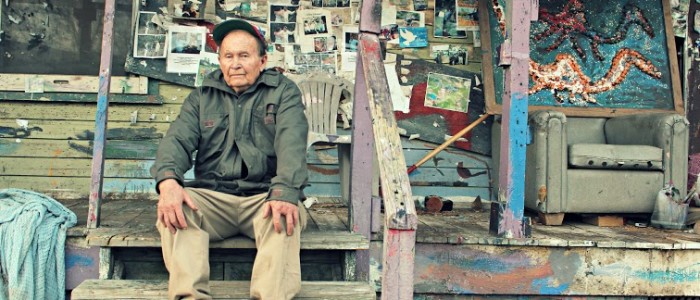
There was a time that when you got to town, you’d know when you were at Clyde’s house. His was the one that was painted with whimsical animals and had a herd of critters in the yard. Now that Clyde’s age has required that he take up residence in a different spot, community members and dear friends of Clyde, including Stephan Meyers, have created a Clyde gallery in his past home. And though Clyde is further down the road these days, Bynum is still like a drive-through folk art gallery, and Clyde’s critters can be spotted in many a yard. During the holidays many are strung with lights. Look for the houses near the intersection of Bynum Church Road and Thompson Recreation Road, and please be respectful of residents.
Best Place to View Clyde’s Paintings: Captain John’s Dockside Restaurant
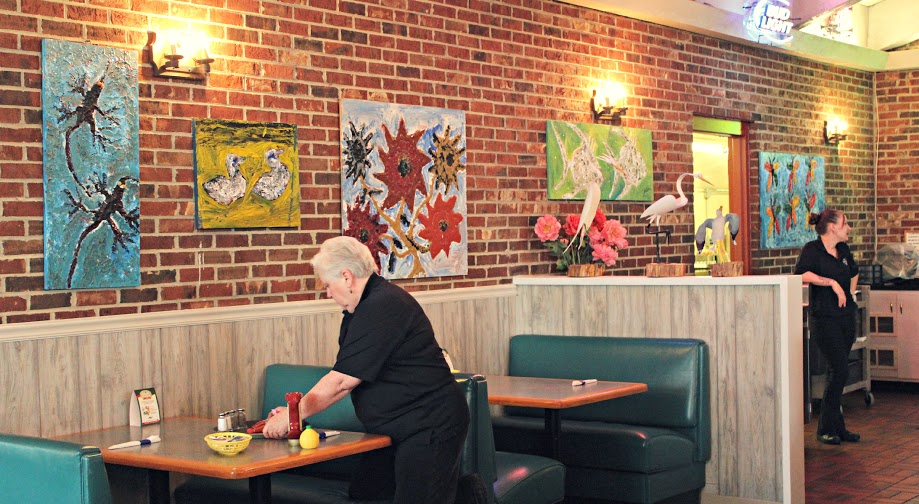
When Clyde stopped in to Captain John’s Dockside for a take-out order more than 30 years ago, he and the new owner John became fast friends. The two met up in “Critterville,” and Clyde invited John to pick out a painting. “Something with a fish, please,” said John. The restaurant now has the largest collection of Clyde paintings in one place, many of them custom made. While he doesn’t make it every week anymore, Clyde still feels happy and at home over a meal at Captain John’s.

Best Place to Get the Big Picture: Downtown Pittsboro’s Clyde Jones Mural
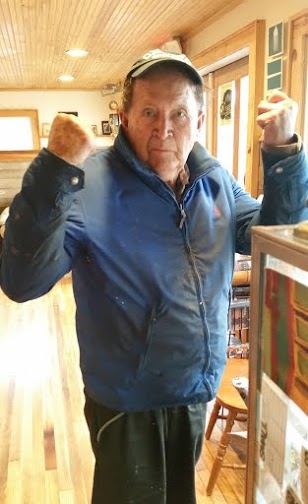
In 2025, Downtown Pittsboro got a Clyde Jones refresh. A crew of Clyde’s local fans led the way, supported by the Town of Pittsboro, the Chatham Arts Council, and Sherwin Williams, in refurbishing an original Clyde mural from decades past. Chatham residents Tami Schwerin and Lyle Estill first asked Clyde to paint a mural on their building back in 1996, and Lyle recounts the history in this essay. Almost thirty years later, muralist Thomas Begley has brought it back to life, and now the largest existing example of Clyde’s community based art is again vibrant and full of energy.
We chatted with restoration muralist Thomas Begley to hear more about his experience with this community treasure. (The interview below has been condensed for space and clarity.)
When did you first learn about Clyde and his work?
I would drive around, and I kind of happened upon spying them on Clyde’s property in Bynum, and I spent a lovely afternoon looking at the critters, and I was just enchanted by it.
I met Clyde only a couple times before he passed. I was lucky to have a chance to have lunch with him. But I felt like I got to know him a lot better through meeting people who really cared about him, like his caretaker Dr. Myers, and John Dimos who owns Captain John’s Dockside on 15-501. It’s a really great place–it’s a wonderful place in its own right. And John was–for years, for decades, I think–one of Clyde’s major supporters and patrons. And so the whole inside is covered in Clyde’s work. And when you go, John wears a little captain’s hat, and he’s just chock full of stories about Clyde and, you know, different sort of funny Clyde anecdotes. And it’s clear that Clyde was really entrenched [in the community]. And people really loved him. So it was exciting for me to have the opportunity to be part of the legacy.
Did you learn anything in particular about Clyde as you went through the process?
The thing that really strikes me about the way that Clyde worked is his real sort of commitment to collaboration–his dedication to the community, especially working with young people. As far as I know, both the mural in Pittsboro and the one that we’re working on right now in Bynum were done in collaboration with, you know, lots of community members of all ages. And it was really important to him. People had the opportunity to make whatever they wanted without reservation or restriction, and I found that really charming.
And did you learn anything about the Chatham community through working on the mural?
I think the important thing is that people really–a lot of people, I think–really recognized that Clyde was something special and different, and they really wanted to take care of him and watch out for him, which I thought was really admirable. And I really got this sense that all of the people that I talked to, there was this real sense that they wanted to support his work without exploiting him, which I think is really–I mean, that’s wonderful. I think sometimes that’s hard to do well as a community–to recognize something that’s good and not try to capitalize on it.
Another thing I thought was really–it was exciting–was that in this area, people are really excited about folk art and interested in these kind of outsider artists. So through Stephan Meyers, who was really, he was like my best friend throughout the Pittsboro mural, and his partner, Gilda (she’s really involved in this huge folk art festival that happens in Fearrington Village), I had also kind of stumbled across the people who had Small B&B Cafe in Pittsboro and had this huge, wonderful collection of folk art that has since moved. The collection, I think, has moved to Siler City. They had shipping containers full of this amazing folk art collection of Howard Finster stuff and all this visionary outsider art. [It’s now at the Alliance in Siler City.] It’s exciting to be in a place where that’s something that people are thinking about, and people are excited about.
What is the process like, to create a mural of that size and scale, and with the particular flavor of the project? Talk me through it.
So, this one, because it was a restoration, it was quite a different process from other sort of big paintings. Because a lot of it was about trying to rescue it from some of the depredations of time, and you know, it was in pretty . . . people had painted on it, and then whitewashed it with a spray paint. There was the whole section that was at ground level was almost entirely obscured. So I had, oh, some really wonderful film photographs that were taken the day that it was painted. And also, I was really helped by the fact that Clyde paints with a really thick brush. He always used a lot of paint on his brushes, and so there’s a really three-dimensional quality to the brushstrokes. So it kind of, even through layers of spray paint, whitewash, whatever, there was sort of this almost like a bas relief of his original.
And I owe a lot of credit to Stephan Meyers, because he has worked in other kinds of restoration and had this interest in preserving it as much as possible, and so he was really, really helpful, and he was sort of talking through it [with me]. So I cleaned it lightly, just to get some of the surface dirt off, and then I put on a clear sealant as an isolation layer. You’re protecting the original work from anything you might do, just in case things go wrong, and also it bonds any sort of old paint background to the brick, so you have a permanent surface that will last for longer. So I clear coated it, and then the thing that took the longest was I had color matched–it was a fun process. Using the photos and then some places the paint had been protected from the sun, I was able to color match the background color, and then outline all of the figures in that background color. And then, I filled in the background, and then from there, I had, sort of these ghost images from the outlining, plus the photographs, and I was able to reconstruct a lot of the critters. It took a long time.
It took a long time ’cause I was working by myself. I think if I were to do it again, I think I would try to work with people. Thinking about what it was probably like on the day, 30 years ago . . . From the photos, it looks like it was kind of like a party atmosphere, and it was this one day of painting, and everyone was just having a good time, and so I felt a little silly to be working these long days all by myself.
Tell me a little bit about what’s coming up next.
Clyde was a longtime Bynum resident. I mean, the people in Bynum really hold him dear. It’s a very unique community within our county. It’s really special, and I think anybody who hasn’t had a chance just to go drive around and walk along the river–it’s really beautiful. The people at the Bynum Front Porch are wonderful; they do these wonderful concerts. They’ve maintained the Bynum General Store really beautifully. And they had put out a call over on Facebook, and they said, We have this Clyde mural–and it’s coming up on a big anniversary for them–so we want this restored, especially considering that he just passed. And so, I had been wanting to work with Stacye Leanza for a long time. I really admire her. She’s a wonderful muralist. She’s done tons of murals and lots of community projects, and I like the process. And so, I approached her about sort of putting a pitch to see if maybe we could put something together. I wanted to honor the spirit of the creation with the Bynum community as a way to continue the heritage of the community project. So we approached the Bynum, and they were excited, and they have been just so wonderful, helping us put together this event. So on May 9, some people in the community are gonna come and help us refresh that mural, too.


Links
- Documentary Preview by Khang Mai
- Short Documentary
- Documentary by James Cox
- 2008 ClydeFEST Documentary
- A short book by Richard Semelka: Clyde Jones: Penguins, Giraffes, and Other Critters, His Joyous Vision
Adapted from an original 2015 article by Bett Wilson Foley.
Leave a Reply